
Revolutionary War Research: Tracing Samuel Williams
This post is the second case study illustrating the research techniques discussed in my series introduction titled Researching Your Revolutionary War Ancestors, where I laid out the essentials for researching Revolutionary-era service.
In my prior case study, I shared the story of my 6th great-grandfather, Lt. William Darling. Now, I’m turning toward another branch of my family tree to explore the service of my 5th great-grandfather, Samuel Williams of Elizabethtown, New Jersey.
Identifying Samuel’s Service Through DAR Sources
In my initial post, I highlighted databases, like the Genealogical Research System (GRS) on the Daughters of the American Revolution website, which can serve as the starting point for your research.
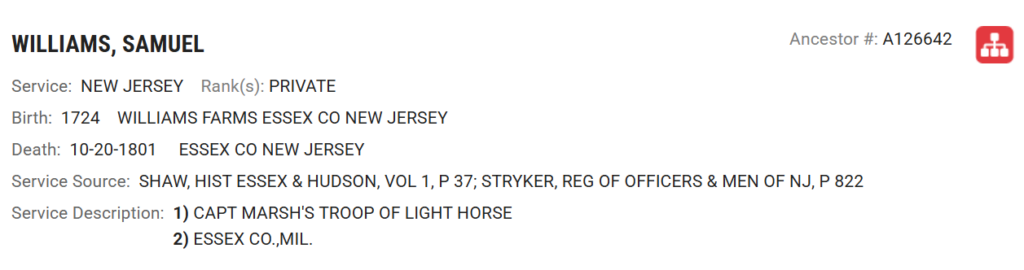
For Samuel Williams, the GRS provides a concise timeline:
- Born in 1724 at Williams Farms in Essex County, New Jersey
- Death 20 October 1801 in Essex County, New Jersey
The Service Description part of the record is where further avenues of research can be investigated. The DAR record provides evidence of his role as a Private in Captain Marsh’s Troop of Light Horse (cavalry unit) within the Essex County Militia.
The database record also points to sources which identify where the information on Samuel’s service was derived:
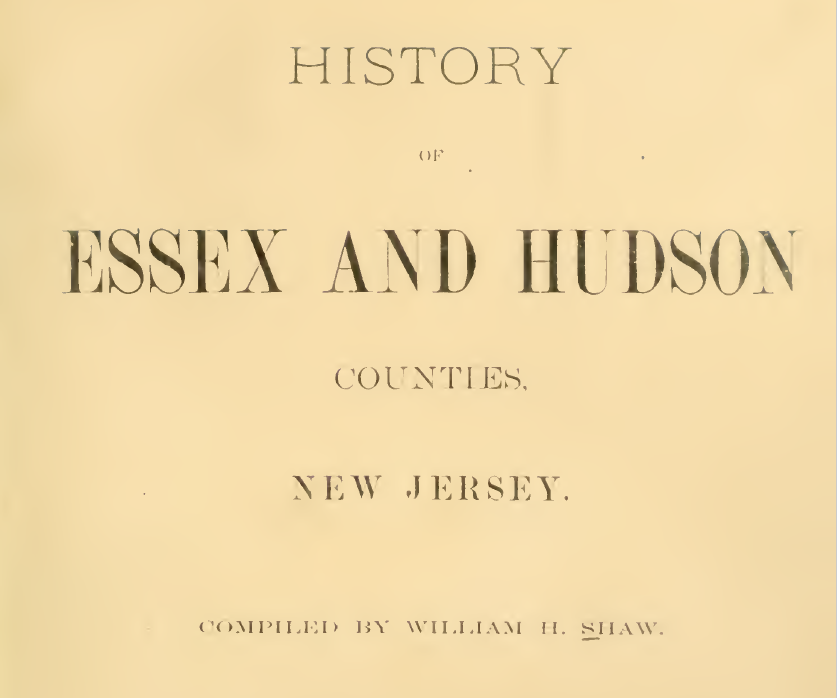
Shaw’s History of Essex & Hudson (Vol. 1, p. 37): A foundational 19th-century county history that provides local context for Elizabethtown. By looking at the broader context of the chapter in which Samuel appears, we see that he was part of a strategic response to the British occupation of nearby Staten Island.
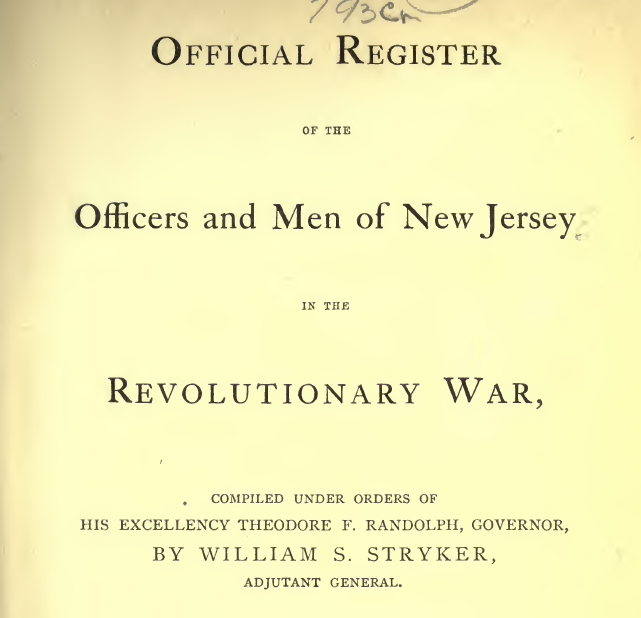
Stryker’s Register of Officers and Men of New Jersey in the Revolutionary War (p. 822): While Shaw’s history provides the local narrative, Stryker’s register provides the official state record, a massive alphabetical roster of every Jerseyman known to have served in local county units.
Using Probate Research to Connect the Generations
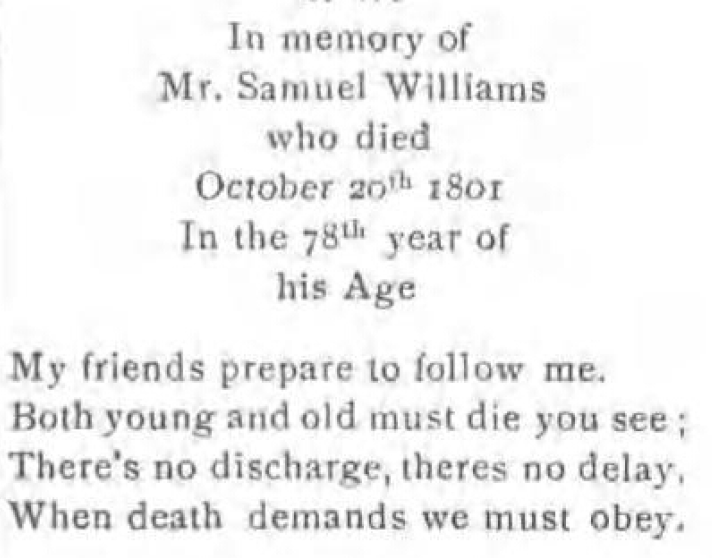
Military service is only part of the research puzzle. In terms of lineage verification, proof of descent is also required. The DAR database, as well as Samuel’s headstone (transcription on the right) provide evidence that he died in October 1801, and was buried in the First Presbyterian Churchyard in Elizabethtown, New Jersey.
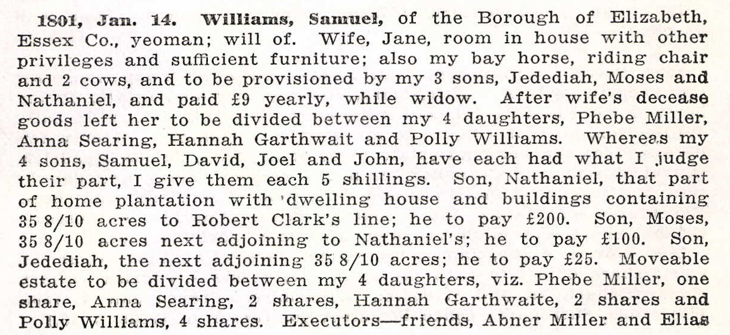
To complement this information, and bridge the gap to Samuel’s son, my 4th great-grandfather Joel Williams, I turned to Samuel’s will abstract. By identifying Joel as an heir to Samuel’s estate, the connection between the generations is proven.
Synthesis of Sources: Connecting Service to Lineage
The strength of this case study lies in the triangulation of disparate records to form a interconnected narrative. While the DAR’s GRS database provided the initial clues, it was the layered approach of using Shaw’s narrative history for local context, Stryker’s register for official state verification, and probate abstracts for familial links that solidified the proof.
By linking Samuel’s documented service in the Essex County Militia to the specific mention of his son Joel as an heir in his will, the multi-generational connection is verified. This methodology, moving from database indexes to primary and secondary sources, is the key to building a lineage that meets evidentiary standards.
Honoring Samuel’s Wife Elenor: The Silent Sacrifice
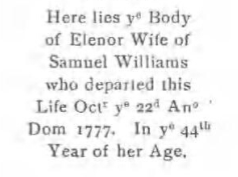
While we often focus on the muster rolls and movements of the Continental Army, the death of Samuel’s wife Elenor, on October 22, 1777, reminds us that the Revolution’s front lines ran directly through the family home.
At that time, Elizabethtown was a community under a constant threat of being raided, where food, livestock, and supplies were routinely seized by both sides, leaving families vulnerable. Elenor did not live to see the independence she helped to support, but her role produced a legacy of endurance that is just as vital to our family story as the battles won in the field.
Williams Family: Future Discoveries
My research into the Williams family continues as I look deeper into the FAN Club (Friends, Associates, and Neighbors) of Essex County. I am currently investigating other Williams individuals who also served in the Revolutionary War to determine if Samuel served alongside brothers or cousins, which was a common occurrence, often providing more clues to break through 18th-century brick walls.
Do You Need Assistance Searching Your Revolutionary War Ancestor?
As we approach the United States Semi-quincentennial, the demand for verified lineage is increasing. If your research into the Founding generation hits a wall, or if you require research for a lineage society application, I am here to help. Whatever kind of research project you have, my specialized research packages are designed to bring your family’s story to light.
Thank you for providing basic information and steps to assist us when researching our ancestors! I love learning where we came from and how those who came before contributed to our lives.
Thank you so much for the kind words! I completely agree, discovering our ancestors’ stories and understanding their impact on our lives is so rewarding!